What Happens in Black Adam?
Get a clear black adam film synopsis covering the plot, key characters, themes, and ending explained in simple terms.
Black Adam is a spoiler-heavy origin story about Teth-Adam, an ancient champion awakened in modern Kahndaq after centuries of imprisonment. A clear black adam film synopsis comes down to four things: Adam's violent return, the Justice Society's attempt to stop him, the truth about his son, and the final battle against Sabbac.
What happens in Black Adam?
The film begins as a buried-hero story and turns into a fight over who gets to define justice in Kahndaq. If you have not watched the movie yet, the most important thing to know is that Adam is not introduced as a clean superhero. He protects people, but he does it with lethal force and little patience for heroic rules.
Adrianna awakens Teth-Adam
In ancient Kahndaq, a tyrant forces enslaved people to mine Eternium and seeks magical power through the Crown of Sabbac. The legend says Kahndaq once had a champion, but the version remembered by the public hides the darker truth of what really happened.
In the present, Adrianna Tomaz enters a tomb to find the crown before Intergang can use it. When Intergang corners her, she reads the ancient words that release Teth-Adam from imprisonment. His first act is not gentle rescue; he destroys the soldiers around him with overwhelming force, immediately setting the tone for the rest of the film.
Black Adam fights Intergang
Once free, Adam turns his power against Intergang across Kahndaq. Tanks, aircraft, and armed soldiers mean very little against him, and the movie quickly shows why ordinary people see him as the first real answer to occupation.
That reaction depends on the viewer's angle. If you are watching from Kahndaq's side, Adam looks like the protector nobody else sent. If you are watching from the Justice Society's side, he looks like a superpowered executioner who may become impossible to control. The film keeps that tension alive instead of making him instantly safe or fully evil.
The Justice Society arrives in Kahndaq
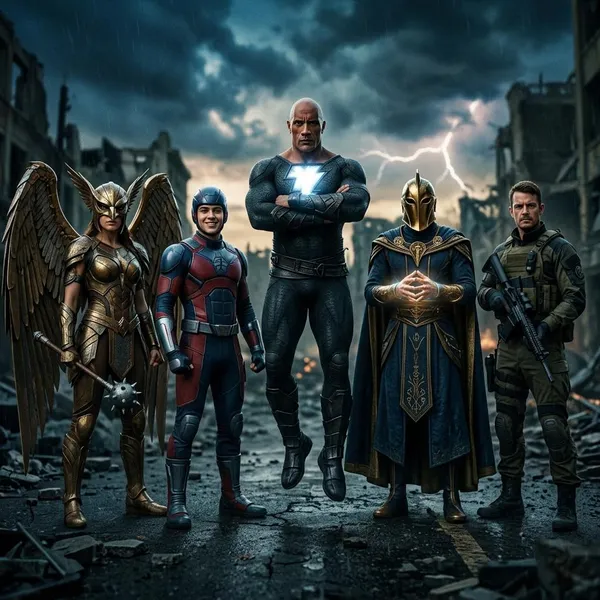
Amanda Waller sends Hawkman, Doctor Fate, Cyclone, and Atom Smasher to stop Adam before his violence spreads further. Hawkman sees restraint as a basic rule of heroism, while Adam sees restraint as a luxury that failed Kahndaq for too long.
Adam's true past is revealed
The major twist is that Teth-Adam was not the original champion. His son, Hurut, received the power first and later transferred it to Adam to save him. After his family was murdered, Adam's grief exploded into catastrophic revenge, destroying the king and much of the kingdom.
This changes the meaning of his imprisonment. Adam was not locked away simply because he failed; he was locked away because his rage made him dangerously uncontrollable. For viewers confused about whether he is supposed to be sympathetic, this is the key detail: his pain is real, but the movie does not pretend his violence is harmless.
Sabbac emerges as the final threat
Ishmael's pursuit of the Crown of Sabbac turns the conflict from occupation and superhero politics into a supernatural threat. After his death, he returns as Sabbac, a demonic figure tied to conquest rather than protection.
Sabbac helps clarify Adam's role. Both characters use ancient power, but Sabbac wants domination, while Adam's worst actions come from grief and a fierce loyalty to Kahndaq. That difference is what pushes Adam closer to antihero territory by the end.
Who are the main characters?
The main characters matter because each one tests Adam from a different direction. Adrianna and Amon connect him to Kahndaq's people, Hawkman challenges his morality, Doctor Fate sees the larger cost, and Ishmael gives the film a villain whose motives are clearly darker than Adam's.
Teth-Adam as Kahndaq's antihero
Teth-Adam is ancient, grieving, and almost impossible to stop once he chooses violence. He does not arrest enemies or worry about heroic image. His instinct is to remove threats permanently, which makes him frightening even when he is fighting on the right side.
Adrianna and Amon as his human allies
Adrianna gives the story its strongest human perspective. She is not waiting for rescue; she acts because Kahndaq has already been left to suffer under Intergang. Her choices bring Adam back, but her real function is to keep the film focused on what occupation feels like for the people living through it.
Amon sees Adam more simply, as the champion Kahndaq needs. That younger, more hopeful view is useful if you are watching the movie for its comic-book mythology: Amon shows why symbols matter, even when the symbol is messy, dangerous, and not fully trustworthy.
Hawkman and Doctor Fate as Justice Society leaders
Hawkman represents heroic rules. He believes power without restraint becomes tyranny, and his clashes with Adam are built around that belief rather than personal hatred.
Doctor Fate is more flexible because he sees possible futures and understands that stopping Adam may not be enough. His calm presence balances Hawkman's certainty, and his role becomes more important as the story moves toward sacrifice instead of simple containment.
Ishmael as the main villain
Ishmael is the main villain because he connects Intergang's present-day control of Kahndaq with the ancient evil behind Sabbac. At first he appears to be another power-hungry figure chasing the crown, but his real goal is transformation into something far more destructive.
How does Black Adam end?
Black Adam ends with Adam returning from imprisonment, fighting Sabbac, and accepting his place as Kahndaq's protector. The ending is not a clean redemption into traditional heroism. It is more specific than that: Adam chooses a purpose, but he keeps the hard edge that made everyone fear him.
Doctor Fate sacrifices himself
Doctor Fate sees a future where Hawkman dies fighting Sabbac, so he chooses to change that outcome. He faces Sabbac alone, sealing the battlefield and buying time for the others.
His death gives the finale more weight than a standard monster fight. Fate is the character most aware of consequence, so his sacrifice feels like a deliberate trade: one life to give Kahndaq, Hawkman, and Adam a chance at survival.
Black Adam returns to fight Sabbac
Before the climax, Adam gives up his powers because he fears what he becomes when rage takes over. That decision matters because it shows he is capable of recognizing his own danger, even if he cannot become gentle.
When Sabbac rises, withdrawal is no longer enough. Adam returns because Kahndaq needs someone strong enough to face a threat the others cannot fully stop. For viewers mainly looking for the ending explained, this is the turn: Adam comes back out of duty, not just revenge.
Sabbac is defeated
Adam, Hawkman, and the remaining heroes fight Sabbac in Kahndaq as the threat spreads through the city. The battle is loud and supernatural, but the important point is simple: Sabbac is too dangerous to be contained through ordinary heroic restraint.
Adam kills him in a way that fits the character. The movie does not soften his methods at the last second. Instead, it lets his brutality become useful against an enemy who represents pure destruction.
Adam accepts the name Black Adam
After Sabbac falls, Adam refuses to sit on the throne and destroys it instead. That choice signals that he does not want to replace one ruler with another tyrant.
What does the ending mean?
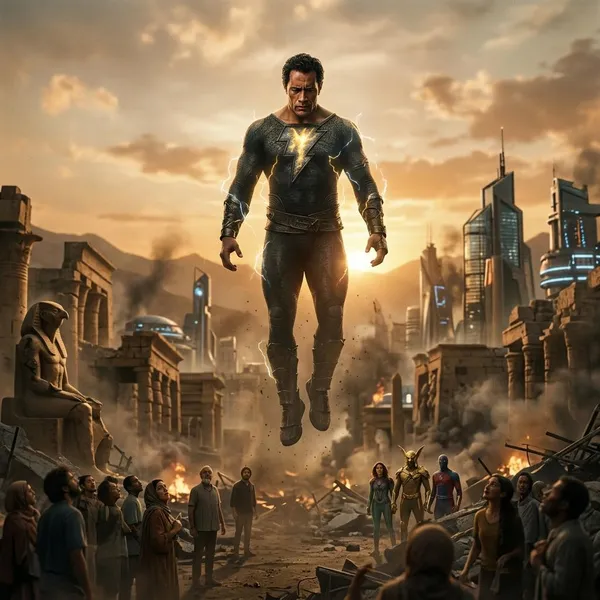
The ending means Adam has chosen protection over domination, but not mercy over violence. If you are watching the film to understand his place in the DC universe, the key is that he ends as a local guardian of Kahndaq rather than a global hero who follows another team's rules.
Adam chooses his own form of justice
Adam does not accept Hawkman's code, Amanda Waller's authority, or the idea that every enemy deserves restraint. His version of justice is severe, personal, and tied to what happened to his family and country.
That makes the ending uncomfortable on purpose. He is not "fixed." He is focused. The film's practical message about him is not that lethal justice is always right, but that Adam will not be judged by the same heroic standard as Superman, Shazam, or the Justice Society.
Kahndaq gains a new protector
Kahndaq finally has someone powerful enough to defend it who also belongs to it. That local connection matters more than a generic "hero saves city" ending, because the film keeps pointing out that outsiders ignored Kahndaq until Adam became a global concern.
The ending confirms his antihero role
The ending confirms that Black Adam sits between hero and villain. He saves Kahndaq and defeats Sabbac, yet he remains willing to kill and reject outside control.
That middle position is the whole point of the character. A normal superhero ending would make him nobler, softer, or more obedient. Black Adam leaves him sharper than that: a protector whose loyalty is clear, even if his methods remain disturbing.
What are the main themes in Black Adam?
The main themes are easiest to see if you compare two viewing situations. If you watch the film mainly for superhero action, the themes explain why Adam keeps clashing with the Justice Society. If you watch it as a story about Kahndaq, the same themes become questions about occupation, outside power, and what people accept when no one else protects them.
Justice versus vengeance
Adam's violence often begins where justice has failed. He believes some threats should be ended completely, while Hawkman argues that heroes must keep limits even when enemies are cruel.
The film does not resolve that debate neatly. It lets vengeance look emotionally understandable in Kahndaq's situation while still showing why Adam's approach scares everyone around him.
Power and responsibility
Adam's power is not just a special effect; it changes who controls Kahndaq and who feels safe there. The responsibility question is sharper because Adam did not start as an idealist. He starts as a grieving father with godlike strength and very little trust in restraint.
Heroism and moral ambiguity
Heroism in Black Adam depends heavily on perspective. The Justice Society are heroes, but their late arrival makes their authority feel complicated. Adam is dangerous, but many people in Kahndaq see him as the first protector who actually answers their crisis.
That gray area is the film's strongest idea. It asks whether a protector can be necessary without being morally clean, and Adam's final role keeps that question open rather than forcing an easy answer.
Conclusion
Black Adam works best when read as an antihero origin rather than a simple hero-versus-villain story. Teth-Adam returns as a destructive figure shaped by grief, but by the end he chooses to stand with Kahndaq against Sabbac without surrendering the harsh code that defines him. That is why the ending feels less like a full redemption and more like a warning: Kahndaq has a protector now, but not a safe or ordinary one.
FAQS
Is Black Adam a hero or a villain?
Black Adam is an antihero. He protects Kahndaq and fights villains, but his willingness to kill keeps him outside the usual superhero category.
Is Black Adam connected to Shazam?
Yes. Black Adam's powers are tied to the same magical mythology as Shazam, although the film mostly tells Adam's story separately from Billy Batson.
What happens in the Black Adam post-credits scene?
Amanda Waller warns Adam not to leave Kahndaq, and Superman appears after Adam refuses to be threatened. The scene teases a possible confrontation, even though later DC plans changed.