What Happens in Bird Box and What Does the Ending Mean?
Get a clear bird box film synopsis with the full plot, ending breakdown, and themes of fear, trust, and motherhood.
The core of a bird box film synopsis is simple: Malorie Hayes tries to keep two children alive in a world where seeing a mysterious force drives most people to suicide. The plot moves between the first days of the outbreak and Malorie's later blindfolded river journey toward a possible refuge. If you only need the ending explained, the key point is that the movie is less about defeating the creatures and more about Malorie learning to choose love instead of emotional distance.
What happens in Bird Box?
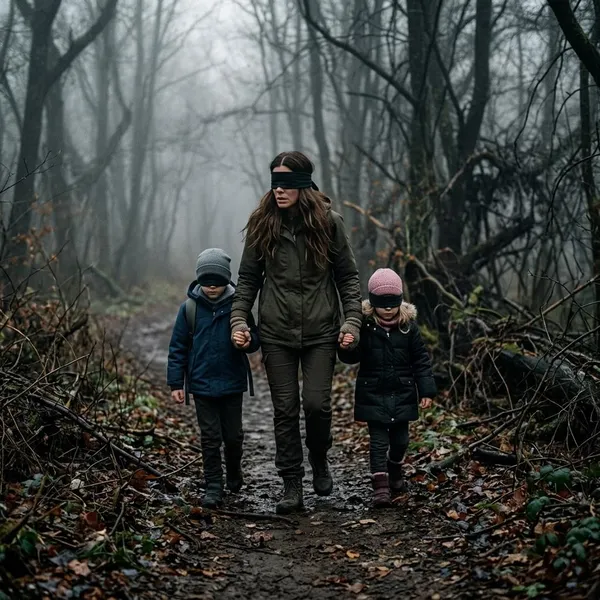
Bird Box is built around two timelines. One shows society collapsing as the unseen entities spread; the other follows Malorie five years later as she takes Boy and Girl down a dangerous river while all three are blindfolded.
The outbreak throws society into chaos
The outbreak reaches Malorie while she is pregnant and leaving a medical appointment with her sister, Jessica. News reports of mass suicides first seem distant, but within minutes the same terror hits the streets around them.
Jessica is exposed while driving and dies after crashing the car, leaving Malorie alone in the middle of the panic. That early loss establishes the film's central rule: in this world, looking for answers can kill you. Sight, usually the safest way to understand danger, becomes the most dangerous sense.
Malorie joins a house of survivors
Malorie is pulled into a nearby house with a small group of survivors, including Tom, Douglas, Olympia, and others. The house becomes a temporary shelter, but it is never comfortable. Windows must be covered, supplies are limited, and every trip outside requires blindfolds and trust.
The safe house section matters because the threat is no longer only outside. The group has to decide when compassion is worth the risk, and that question becomes deadly later.
Gary brings deadly danger into the house
Gary arrives injured and claims he needs help. Letting him in looks like the humane choice, but he has already been changed by exposure to the entities. Instead of dying, he has become obsessed with making others look.
His betrayal turns the house from a refuge into a trap. He uncovers the windows during childbirth, exposing several survivors and destroying the fragile safety the group had built. It is one of the film's clearest warnings: in this apocalypse, the wrong person inside the house can be as dangerous as the force outside.
Malorie and Tom raise the two children
After the safe house falls apart, Malorie and Tom care for two newborns: Malorie's son and Olympia's daughter. Five years later, they live as a small family, using strict rules to survive. The children are called Boy and Girl, not because Malorie does not care, but because she is afraid that naming them will make loss unbearable.
Malorie takes the children down the river
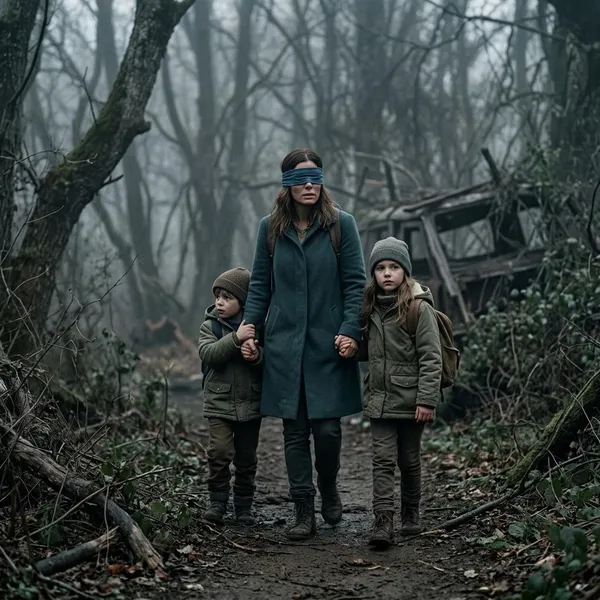
When Malorie hears a radio message about a sanctuary, she decides to risk the river journey. Staying hidden may feel safer in the short term, but the house is not a future. The river becomes the film's practical test: can three people move through woods, water, rapids, and hostile voices without using sight?
For viewers who remember the river more than the safe house, this is why: the journey compresses the whole movie into one situation. Malorie must protect the children with rules, but she also has to prove that she values them as more than lives to be managed.
How do the entities in Bird Box work?
The entities in Bird Box are never fully identified. The film gives rules rather than a complete mythology: if most people see them, they suffer overwhelming visions and kill themselves. A smaller number of exposed people survive but become dangerous followers who want others to look too.
Seeing them triggers fatal visions
Looking at the entities causes an immediate psychological collapse in most people. Victims appear to see something unbearable, often connected to fear, grief, guilt, or personal trauma, although the film never confirms one exact mechanism.
The decision not to show the creatures clearly is part of the horror. A fully visible monster would give viewers something fixed to judge. By keeping the entities unseen, the movie lets the threat feel personal, unstable, and impossible to master.
Blindfolds protect survivors outside
Blindfolds are the basic survival tool because they block visual exposure. They do not make the outside safe; they simply trade one danger for another. A blindfolded person avoids the entities but becomes vulnerable to cars, stairs, rivers, trees, attackers, and panic.
- Inside: cover windows before doing anything else.
- Outside: move slowly and rely on sound, touch, memory, and commands.
- With children: obedience matters because curiosity can be fatal.
Birds react when the entities are near
Birds act as an early warning system. When the entities are close, the birds become agitated, giving survivors a signal they can hear instead of see.
The birds also explain the title in a practical way. They are not weapons and they do not understand the creatures, but they give Malorie and the children a few extra seconds to react. In the river sequence, that small warning can be the difference between staying focused and giving in to fear.
Some exposed people become dangerous followers
Not everyone who sees the entities dies. Some exposed people become followers who seem devoted to the beings and try to force others to look. Gary is the most important example because he uses trust as a way into the safe house.
How does Bird Box end?
Bird Box ends with Malorie and the children reaching a sanctuary in a former school for the blind. The ending is hopeful, but not because the entities are defeated. It is hopeful because Malorie finally finds a community and allows herself to love the children openly.
Tom sacrifices himself to protect the family
Tom dies while protecting Malorie and the children from hostile followers. He exposes himself during the fight, buying them the chance to escape.
His death matters because he has been the emotional balance in the family. Malorie is capable and fierce, but Tom keeps hope alive in a gentler way. Once he is gone, Malorie has to carry both roles: protector and emotional anchor.
Malorie and the children reach the sanctuary
After surviving the river and moving through the woods, Malorie follows the sanctuary's instructions and reaches the entrance with Boy and Girl. The entities still pressure them, using voices and fear to tempt them into removing their blindfolds.
The scene works because the danger is no longer just physical. Malorie is exhausted, grieving, and terrified, yet she keeps the children moving. If you are watching mainly for the thriller plot, this is the escape payoff. If you are watching Malorie's character arc, it is the moment she proves she can lead through fear without being ruled by it.
The school for the blind offers a safe refuge
The sanctuary is a former school for the blind, which gives the ending a practical and symbolic logic. People who already know how to live without sight are better prepared for a world where looking outside can kill.
The refuge does not solve the apocalypse. The entities remain outside, and the wider world is still broken. What it offers is more modest but more believable: routines, community, birds, shelter, and a chance for children to grow up around people instead of silence and rules alone.
Malorie finally gives the children names
At the sanctuary, Malorie names the children Tom and Olympia. The names honor the people who helped them survive and show that Malorie no longer sees attachment only as a weakness.
This is the emotional ending of the film. Calling them Boy and Girl kept the children at a distance; naming them gives them identity, memory, and belonging. Malorie has not become less cautious, but she has become less closed off.
What are the main themes in Bird Box?
The main themes in Bird Box are fear of the unknown, motherhood, trust, and hope after collapse. The film uses its horror premise to ask a more personal question: what kind of life is left if survival requires people to shut themselves off from the world and from one another?
Fear of the unknown
The film's strongest fear comes from not knowing what the entities are. Survivors can identify patterns, but they cannot study the threat directly, fight it, or fully explain it.
That uncertainty changes the usual horror logic. The smartest person is not the one who sees more, but the one who accepts the limit and adapts. The film is especially effective for viewers who prefer psychological horror, because the unseen threat leaves room for the imagination to do the worst work.
Motherhood and emotional growth
Motherhood in Bird Box is not shown as instant softness. Malorie's love first looks like discipline: strict commands, hard rules, and little room for comfort. In her situation, that severity is partly reasonable because one careless glance can kill.
Trust and human survival
Trust is necessary in Bird Box, but it is never simple. The safe house only works when people share labor, rules, and information. At the same time, Gary proves that kindness can be exploited.
- Total isolation may reduce betrayal, but it leaves people weaker over time.
- Blind trust can destroy a group, especially when outsiders arrive.
- Careful trust is the film's middle path: help when possible, but keep rules firm.
Hope in a collapsing world
Hope in Bird Box is small, practical, and unfinished. The sanctuary is not a cure, and Malorie does not get her old life back. What she gets is a place where the children can be more than survivors.
That makes the ending feel earned rather than sentimental. The movie does not pretend fear disappears; it shows that people can still build routines, remember the dead, protect one another, and choose a future even when the world remains dangerous.
Conclusion
Bird Box works because its survival story and emotional story point in the same direction: staying alive is not enough if fear strips away every bond that makes life worth protecting. The unseen entities create the suspense, but Malorie's final choice to name the children gives the film its real resolution. The ending is not a victory over the creatures; it is a hard-won step toward trust, memory, and a livable future.
FAQS
Are the creatures in Bird Box ever explained?
No. The film explains what the entities do, not where they come from or what they truly are. That mystery is deliberate, and it keeps the horror focused on reaction rather than monster lore.
Is Bird Box based on a book?
Yes. Bird Box is based on Josh Malerman's 2014 novel of the same name. The movie keeps the core premise but changes some details in pacing, character focus, and presentation.
What is the main message of Bird Box?
The main message is that survival needs more than caution. Rules keep Malorie and the children alive, but love, trust, and belonging are what make that survival meaningful.