How Is AI Transforming Vertical Dramas?
Discover how ai vertical drama is planned, produced, and edited for mobile viewers with strong hooks and cliffhangers.
AI vertical drama is worth understanding if you want fast, phone-native storytelling without building a full film set for every episode. The format can be made by one creator or a small team, but it only works when the story hook, character consistency, captions, and rights checks are handled deliberately.
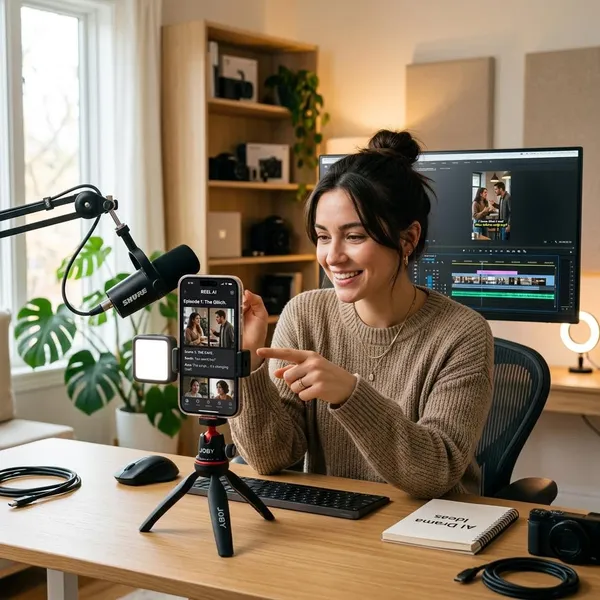
What is AI vertical drama?
AI vertical drama is a short serialized drama format made for 9:16 mobile screens, with AI used to support part or all of the production process. The "vertical drama" part refers to the phone-first viewing style; the "AI" part refers to tools that may help with scripts, visuals, voices, music, captions, editing, or testing variations.
Vertical 9:16 storytelling for mobile
Vertical 9:16 storytelling is designed for a phone held upright. Faces, hands, messages, documents, and reactions need to be easy to read without asking the viewer to rotate the screen or study a crowded frame.
This is why close framing usually works better than wide staging. A jealous glance at a wedding, a hidden text on a phone, or a contract being torn up can carry more weight than a complicated scene with five people spread across the frame.
Short serialized episodes with recurring characters
Most AI vertical dramas use very short episodes built around one clear story turn: a reveal, accusation, confession, reversal, or decision. The episode does not need to solve the whole plot. It needs to make the next episode feel necessary.
Recurring characters are the anchor. Viewers may forgive a simple plot if they can instantly recognize who matters, what each person wants, and why the conflict keeps escalating.
AI-assisted production across the workflow
AI can assist the workflow in several places:
- Story planning: testing hooks, episode beats, and cliffhanger options.
- Visual creation: generating characters, locations, shots, or backgrounds.
- Audio: creating voice tracks, music beds, and sound cues.
- Post-production: captions, pacing tests, continuity fixes, and alternate edits.
The strongest use case is usually acceleration, not full replacement. A solo creator testing a three-episode pilot may rely heavily on AI to move quickly; a commercial team may use it more selectively to protect quality and brand safety.
How AI vertical drama differs from traditional vertical drama
Traditional vertical drama is usually filmed with actors, locations, crew, and live camera work. AI vertical drama shifts more of that work into software, which changes the budget, speed, creative control, and failure points.
The biggest difference is not simply "AI versus filming." It is control. In live production, an actor's face, voice, and presence naturally carry continuity. In AI-heavy production, the creator has to build that continuity through references, prompts, editing rules, and careful review.
Faster production and iteration
AI makes it easier to test versions quickly. If the first five seconds feel slow, a creator can try a sharper opening line, a closer shot, or a different music cue without scheduling another shoot.
More AI-generated creative assets
An AI vertical drama may include generated character images, synthetic voices, AI-assisted backgrounds, music, captions, or even full video shots. This can lower the barrier for creators who do not have actors, locations, or a production crew.
The trade-off is uneven quality. A single reaction shot may look convincing, while a longer emotional exchange may feel stiff or inconsistent. A sensible workflow uses generated assets where they help most, then cuts anything that distracts from the drama.
Greater focus on consistency controls
Consistency is a production requirement, not a final polish. If the lead character's face, hair, wardrobe, or voice shifts too much, viewers have to work out whether they are watching the same person.
- Lock identity early: keep reference images and character descriptors stable.
- Limit avoidable variation: do not change outfits, lighting, and locations at once unless the story needs it.
- Review as a viewer: watch episodes in order and check whether recognition feels instant.
Different cost and quality trade-offs
AI can reduce upfront production costs, especially for a creator making a proof of concept. The hidden cost is time spent regenerating scenes, fixing continuity, cleaning captions, and choosing usable takes.
Traditional filming is still stronger when physical performance, subtle acting, or complex interaction matters. AI vertical drama is more attractive when the goal is fast concept testing, short serialized output, or a stylized story that can tolerate some artificiality.
How an AI vertical drama is made
A good AI vertical drama starts with a small, controllable story system. Before generating clips, decide what the series is promising: revenge, romance, betrayal, family pressure, secret identity, or another emotional engine that can produce repeated turns.
Develop the hook and series arc
Start with the question a viewer should understand in seconds: Who is being wronged? What secret is about to come out? What decision will change the relationship? A vague premise is hard to save later, even with polished visuals.
For a short pilot, three to five episodes is often enough to test whether the engine works. Each episode should create one consequence that naturally pushes into the next, rather than stacking random shocks.
Lock the characters and visual style
Before making many scenes, define the main characters in a way your tools can repeat. Use stable reference images, recurring wardrobe notes, age range, voice direction, and role in the conflict.
| Control point | Why it matters | Quick check |
|---|---|---|
| Face and hair | Prevents identity drift | Can a viewer recognize the character in one second? |
| Wardrobe | Supports continuity | Are outfit changes intentional in the story? |
| Voice tone | Keeps personality stable | Does the character sound like the same person across episodes? |
| Visual mood | Protects genre feel | Does the scene still look like the same series? |
Break the script into vertical scenes
Write scenes for the phone screen, not for a wide frame squeezed into portrait. One confrontation, one reveal, or one decision is usually enough for a short episode.
Generate shots, voices, and music
When generating assets, give the tool enough direction to reduce waste: character name, emotional state, framing, setting, action, and any continuity detail that must not change. Vague prompts often create scenes that look interesting but cannot be edited into the episode.
Audio deserves the same care. A synthetic voice that is too flat can make a strong twist feel weak, and music that is too loud can bury the line that explains the scene.
Edit for pace and continuity
Editing is where the episode either becomes watchable or falls apart. Check the first seconds, the middle beat, and the final turn separately: does the opening create a question, does the middle stay clear, and does the ending create pressure to continue?
- Cut soft openings: start closer to the conflict.
- Remove confusing shots: a pretty clip is not useful if it breaks continuity.
- Clean captions: viewers should understand the plot even with low sound.
Publish and refine future episodes
Publish in a way that lets you learn before scaling. A small creator might test a short batch on TikTok, Reels, or Shorts; a more serious commercial project should also check rights, platform rules, and whether the production system can sustain many episodes.
Look at where viewers drop off, which characters get comments, and whether people understand the cliffhanger. Then refine the system: tighten prompts, adjust pacing, simplify scenes, or retire a plotline that only works on paper.
What makes AI vertical drama work on mobile
Mobile viewing is impatient, small-screen, and often silent or semi-silent. AI vertical drama works when the viewer can understand the conflict immediately, recognize the characters quickly, and follow the emotion without rewinding.
Hook viewers in the opening seconds
Open with tension already on screen. A hidden message, a public accusation, an interrupted wedding, or a character being recognized under a false identity gives the viewer a reason to stay.
Focus each episode on one key turn
Each episode should have one main turn that changes the situation. If you try to include three reveals, two emotional reversals, and a new character introduction in one minute, the episode usually feels noisy instead of addictive.
End with a clear cliffhanger
A strong cliffhanger is specific. "Someone walks in" is weaker than "the woman he betrayed walks in holding the contract he thought was destroyed." The viewer should know exactly what question the next episode must answer.
Keep characters visually consistent
Visual consistency is especially important when episodes are short. Viewers do not have time to re-learn the cast, so identity cues need to stay stable from scene to scene.
For a low-stakes test, small imperfections may be acceptable if the story is clear. For a paid series, branded channel, or sponsor-backed release, inconsistency becomes a bigger risk because it can make the whole production feel unfinished.
Make dialogue and captions easy to follow
Dialogue should carry plot and emotion at the same time. Short, pointed lines usually work better than long speeches, especially when viewers are watching on a bus, during a break, or with the sound low.
- Keep captions readable: avoid tiny text and crowded lower thirds.
- Time lines cleanly: captions should match the spoken beat.
- Protect key visuals: do not cover faces, messages, or evidence with text.
Main limits of AI vertical drama
AI vertical drama is useful, but it is not a shortcut around storytelling judgment. The main limits show up when creators publish too quickly, trust generated output too much, or treat familiar tropes as a substitute for character motivation.
Character and scene inconsistency
Generated characters can drift between scenes, and locations can change in small but distracting ways. A hallway, office, or bedroom that subtly mutates may not ruin a single clip, but it weakens a serialized story over time.
Repetitive story patterns
AI can produce endless variations of revenge, hidden wealth, fake marriage, betrayal, and public humiliation plots. Those tropes are popular because they are instantly understandable, but they become dull when nothing personal or surprising is added.
Uneven emotional continuity
A character may look right but react wrong. If anger, fear, grief, or attraction does not build from the previous beat, the scene feels artificial even when the visuals are clean.
Keep emotional movement simple when the tools struggle. One strong reaction, held for the right length, is often better than several generated expressions that do not connect.
Rights and likeness concerns
Rights and likeness issues matter as soon as the project becomes public, and they matter more if money is involved. Avoid voices, faces, logos, music, or character designs that appear to imitate real people, protected brands, or copyrighted work without permission.
For a private experiment, the risk may feel distant. For monetized episodes, sponsored content, or app distribution, use properly licensed assets and review platform terms before publishing.
Limited creative judgment without human direction
AI can generate options, but it cannot reliably decide which version has the clearest tension, strongest payoff, or most believable emotional rhythm. Someone still has to choose, cut, rewrite, and say no.

Conclusion
AI vertical drama is most useful when you treat it as a controlled production method, not a magic button for instant storytelling. Start with a strong mobile hook, lock the characters before scaling, keep each episode focused, and be more cautious with rights and consistency if the project is public or commercial.
FAQS
Can one person make an AI vertical drama?
Yes, one person can make a small AI vertical drama, especially as a pilot or test series. The harder part is keeping characters, voices, pacing, and captions consistent across multiple episodes.
How do creators keep characters consistent?
They use reference images, fixed character notes, stable wardrobe details, saved voice settings, and repeated review passes. Limiting the number of locations and outfit changes also helps.
Is AI vertical drama fully AI-generated?
Not always. Many projects are AI-assisted, with humans still writing, directing prompts, selecting takes, editing scenes, and making final story decisions.